Fleet management
Keep every vehicle ready for the next booking
Organize vehicle details, pricing, availability, photos, and maintenance records from one rental dashboard.
Start your free trial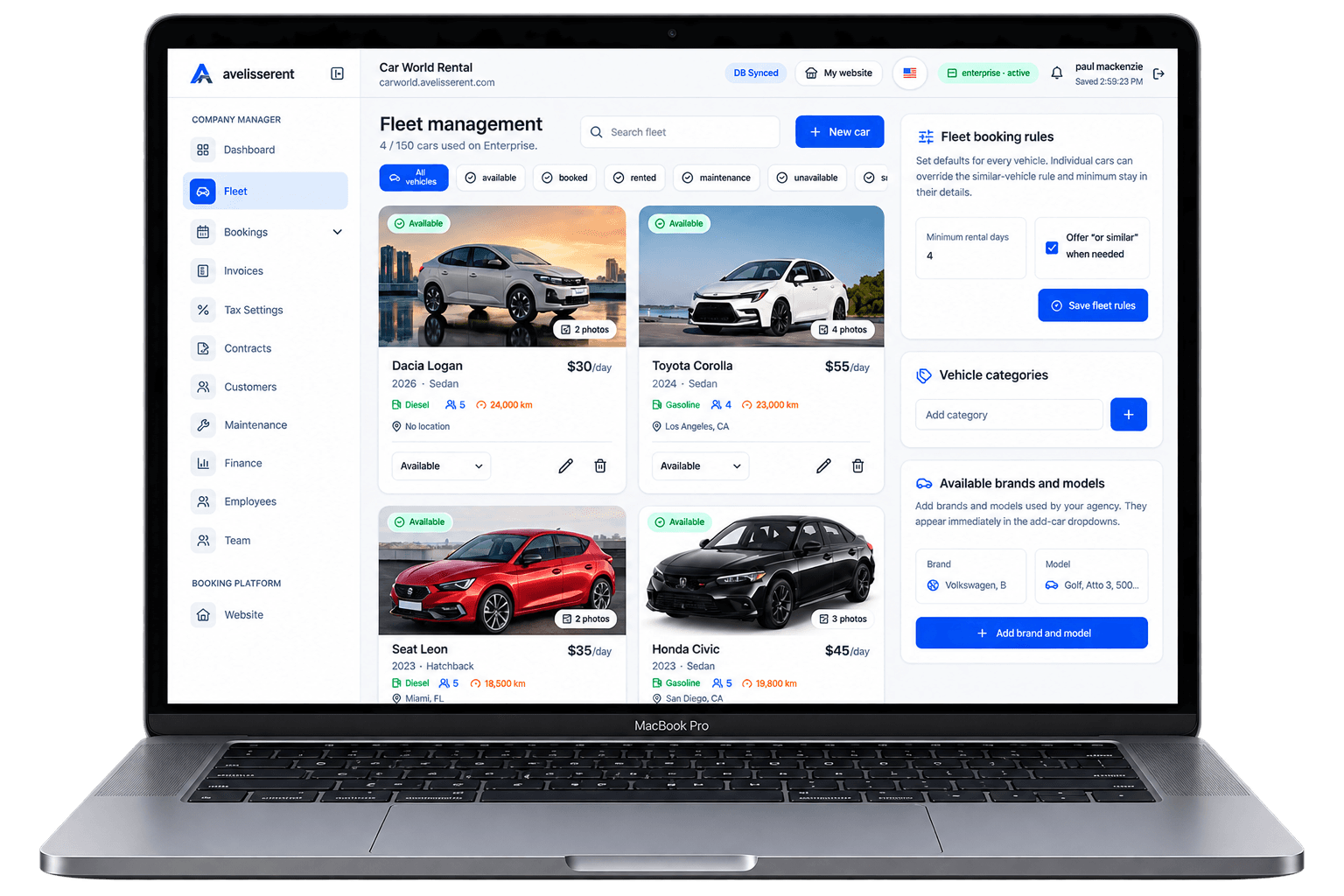
A practical car rental pricing strategy starts with a defendable cost floor, then adjusts rates by vehicle class, demand, lead time, rental length, and real fleet availability. The goal is not to copy the cheapest competitor. It is to make consistent decisions that protect margin, keep prices understandable, and put the right vehicle in front of the right customer at the right time.
This guide gives independent agency owners a repeatable framework. It deliberately avoids “average daily rate” claims because markets, taxes, insurance, vehicle costs, and demand patterns vary widely. Use your own records, local market observations, and booking data.
What should a car rental pricing strategy accomplish?
A useful strategy gives your team an answer to four questions:
- What is the lowest sensible rate for this vehicle class?
- When should the rate move up or down?
- Which booking conditions should change the total price?
- Who reviews and approves exceptions?
Pricing should work with availability rather than in isolation. A vehicle that is already heavily booked for a holiday weekend does not need the same decision as an underused vehicle next Tuesday. If you need a broader operating foundation first, read the car rental fleet management guide.
Step 1: Calculate a defendable rate floor
Your rate floor is not automatically the price customers see. It is an internal guardrail that helps you recognize bookings that may not cover the work and risk involved.
Start with the costs associated with keeping a vehicle rentable:
- Lease, financing, or depreciation allocation
- Insurance and registration
- Scheduled maintenance and a repair reserve
- Cleaning and turnaround labour
- Parking, tracking, and other vehicle-level costs
- A reasonable allocation of rent, software, administration, and other overhead
A simple planning formula is:
Daily cost floor = monthly vehicle and allocated operating costs ÷ expected rentable days
“Expected rentable days” should reflect planned maintenance and realistic availability, not every calendar day. Then decide what contribution margin the booking must add above that floor. Do not forget costs created by the booking itself, such as delivery, payment processing, extra cleaning, or branch transfers.
Illustrative example—not a market benchmark
Imagine that a compact vehicle carries 900 monetary units in monthly vehicle and allocated operating costs. If the agency expects 20 rentable days, its planning floor is 45 units per rentable day before the desired margin, taxes, optional extras, or booking-specific costs. The numbers are fictional; the method is what matters.
Build the same calculation for each class. An economy car, seven-seat vehicle, cargo van, and premium SUV usually should not share one generic rule.
Step 2: Segment the decisions that genuinely affect price
A long list of rate rules can become impossible for staff to explain. Begin with the few factors that materially change your demand, cost, or risk.
Vehicle class
Set a base rate by class, not by instinct at the counter. Vehicles within a class can still have different internal costs, but the customer-facing structure should remain clear.
Booking lead time
Compare bookings made weeks ahead with same-day requests. A short lead time can signal urgency, but it can also be your last chance to rent an idle vehicle. Let actual booking pace and remaining availability guide the decision.
Rental length
A weekly rate can reduce turnaround work and idle gaps, but a discount is only sensible if the lower daily amount still covers the longer commitment and the dates you give up. Define the rule in advance instead of negotiating every enquiry.
Dates and local demand
Mark public holidays, school breaks, festivals, major conferences, and your own recurring peak periods. Use location-relevant events only; adding unrelated city keywords or prices does not create useful local relevance.
Pickup conditions and extras
Delivery, one-way returns, after-hours service, mileage packages, additional drivers, and optional equipment can change the workload. Show them as clear components rather than hiding them inside an unexplained total.
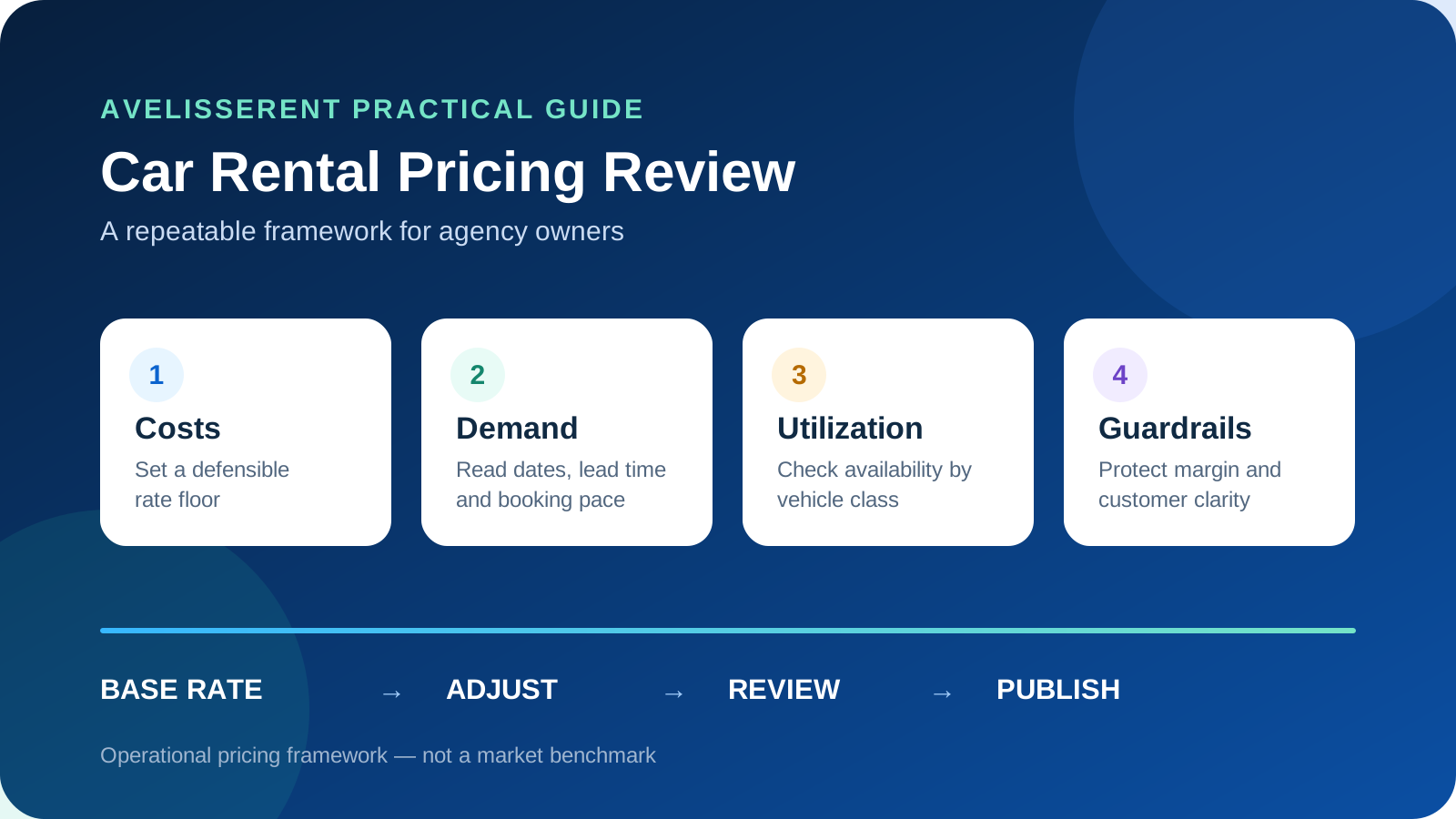
Step 3: Apply a four-layer pricing framework
Use the same order every time. This makes the final rate easier to audit and explain.
- Base rate: choose the starting rate for the vehicle class from the cost floor, class positioning, and standard service level.
- Demand adjustment: raise, hold, or reduce within approved limits after reviewing booking pace, remaining fleet, lead time, and relevant local dates.
- Booking conditions: apply documented duration, location, mileage, and optional-extra rules so the customer sees a transparent total.
- Guardrails: check the rate floor, maximum approved change, customer clarity, and any exception that needs approval.
This framework is deliberately manual-friendly. A small agency can run it in a spreadsheet; a larger team can formalize it in its operating system. The important part is that a rate change has a reason, an owner, and a review date.
Step 4: Review rates with availability, not guesswork
A high rate is not helpful if the class remains idle, and a fully booked class may be underpriced. Review the relationship between rate, demand, and availability. The companion guide on improving car rental fleet utilization explains how to protect availability without damaging the customer experience.
For each vehicle class, examine:
- Available vehicles for the next 7, 14, and 30 days
- New bookings and cancellations since the previous review
- Days with no availability or repeated turnaways
- Idle gaps that are difficult to fill
- Average rental length and booking lead time
- Recent exceptions granted by staff
Do not react to one competitor screenshot. Check comparable vehicle classes, dates, mileage, taxes, deposit rules, cancellation terms, and pickup conditions. A cheaper headline can represent a different offer.
A weekly car rental rate-review template
Run a short meeting with one row per vehicle class. The owner of the decision should record why the rate changed.
- Vehicle class: economy, compact, SUV, van, premium, or your local categories.
- Current base rate: the present standard amount and currency.
- Review period: the dates being priced.
- Available units: real availability after confirmed bookings and maintenance blocks.
- Booking pace: new bookings, cancellations, and enquiries since the last review.
- Local demand note: only a verified holiday, event, season, or recurring pattern.
- Comparable offers: like-for-like local observations, including conditions.
- Decision: raise, hold, reduce, or change a booking rule.
- Reason and owner: one sentence and one accountable person.
- Review date: when the decision will be checked again.
Keep a simple decision log. After several cycles, you can compare the expected result with actual bookings and refine the rules instead of restarting from opinion each week.
An example pricing decision
Suppose a fictional agency reviews its compact class for a three-day local festival:
- The cost floor and standard base rate are already documented.
- Most compact vehicles are reserved for the festival dates, while the week after remains open.
- Comparable local offers are checked using the same dates, class, mileage, and mandatory charges.
- The agency raises the compact-class rate only for the high-demand dates, keeps the following week unchanged, and records the reason.
- It schedules another review in three days rather than leaving the change permanent.
The example is useful because the decision is narrow and reversible. It does not turn a temporary event into a permanent pricing assumption.
Common car rental pricing mistakes
Copying the lowest visible competitor price
You may be comparing a restricted offer, a different vehicle class, a prepaid rate, or a total that excludes mandatory charges. Compare the full booking proposition.
Using one rate all year
A fixed rate ignores changes in demand and availability. Even if you do not use dynamic pricing, scheduled reviews are better than permanent autopilot.
Discounting without a purpose
Every discount should answer a business question: Does it fill a specific idle period, reward a longer rental, or support a defined customer segment? “The customer asked” is not a complete policy.
Changing prices without updating customer-facing information
Your website, written confirmation, contract, and invoice should describe the same agreed amount and conditions. A clean online booking workflow reduces re-entry and pricing surprises.
Ignoring operational constraints
An aggressive rate can attract bookings your team cannot deliver reliably. Cleaning time, maintenance, branch transfers, and vehicle substitutions belong in the decision.
How software supports pricing execution
Pricing strategy remains a management responsibility. Software helps by keeping the information behind each decision organized and by carrying an approved rate through the customer journey.
With connected car rental software features, an agency can keep vehicle records, availability, bookings, customer records, contracts, invoices, payments, team access, and reporting in one workflow. This reduces the risk that the website shows one amount while the desk, contract, or invoice uses another.
AvelisseRent does not replace the agency’s judgement in this framework. The agency defines its rates, rules, exceptions, and review process; the platform supports consistent execution across the branded booking website and rental operations.
30-minute implementation checklist
- Choose one vehicle class for the pilot.
- Calculate its monthly vehicle and allocated operating costs.
- Choose realistic rentable days and document the cost floor.
- Write one standard base rate and its included mileage or services.
- Select two demand signals you can reliably review.
- Define duration, delivery, and after-hours rules.
- Set a minimum-rate guardrail and name the exception approver.
- Create the weekly review table and assign an owner.
- Check the rate in the website, confirmation, contract, and invoice workflow.
- Review the result after one week before expanding to other classes.
Frequently asked questions
How often should a small car rental agency review rates?
A weekly review is a practical starting point, with additional checks before known peak dates or when availability changes quickly. The right frequency depends on booking volume and how far ahead customers reserve.
Should my rates match competitors?
No. Competitor offers are one input, not your cost structure or strategy. Compare like-for-like offers, then decide using your floor, availability, service level, and booking conditions.
Are longer-rental discounts always profitable?
No. A longer booking can reduce turnaround work and idle gaps, but it also removes the vehicle from other dates. Test the total contribution and opportunity cost rather than assuming a lower daily rate is always better.
Do I need dynamic pricing software?
Not necessarily. Begin with documented base rates, clear guardrails, and a consistent review rhythm. Automation becomes useful when the team has trustworthy data and rules it understands; it should not automate unexplained decisions.
Start with one class and one review cycle
The strongest car rental pricing strategy is understandable enough to use every week. Calculate a floor, segment the decisions, review real availability, record the reason, and keep the customer-facing total clear.
When you are ready to connect pricing with fleet availability, bookings, customer records, contracts, invoices, payments, team access, and analytics, you can start a seven-day AvelisseRent trial.
Sources and methodology
- U.S. Small Business Administration: market research and competitive analysis — a general framework for using demand, market size, saturation, and competitor information.
- HQ Rental Software FAQ and Rent Centric product overview — reviewed on 21 September 2026 to understand current competitor topic coverage and software positioning. No wording, imagery, or unsupported product claims were reused.
This article provides an operational planning framework, not legal, tax, accounting, or jurisdiction-specific pricing advice.

Mohamed Elazzabi
Founder & CEO of Avelisse Labs LLC | SaaS & App Developer | Content Creator
I'm Mohamed Elazzabi, Founder and CEO of Avelisse Labs LLC Launching AvelisseRent SaaS platform built to help car rental businesses simplify and automate their daily operations. I create content about car rental business growth, digital transformation, automation, SaaS, and technology, sharing practical ideas to help rental agencies work smarter, reduce manual tasks, improve customer experience, and grow their business. Building smarter tools for modern car rental businesses.