Fleet management
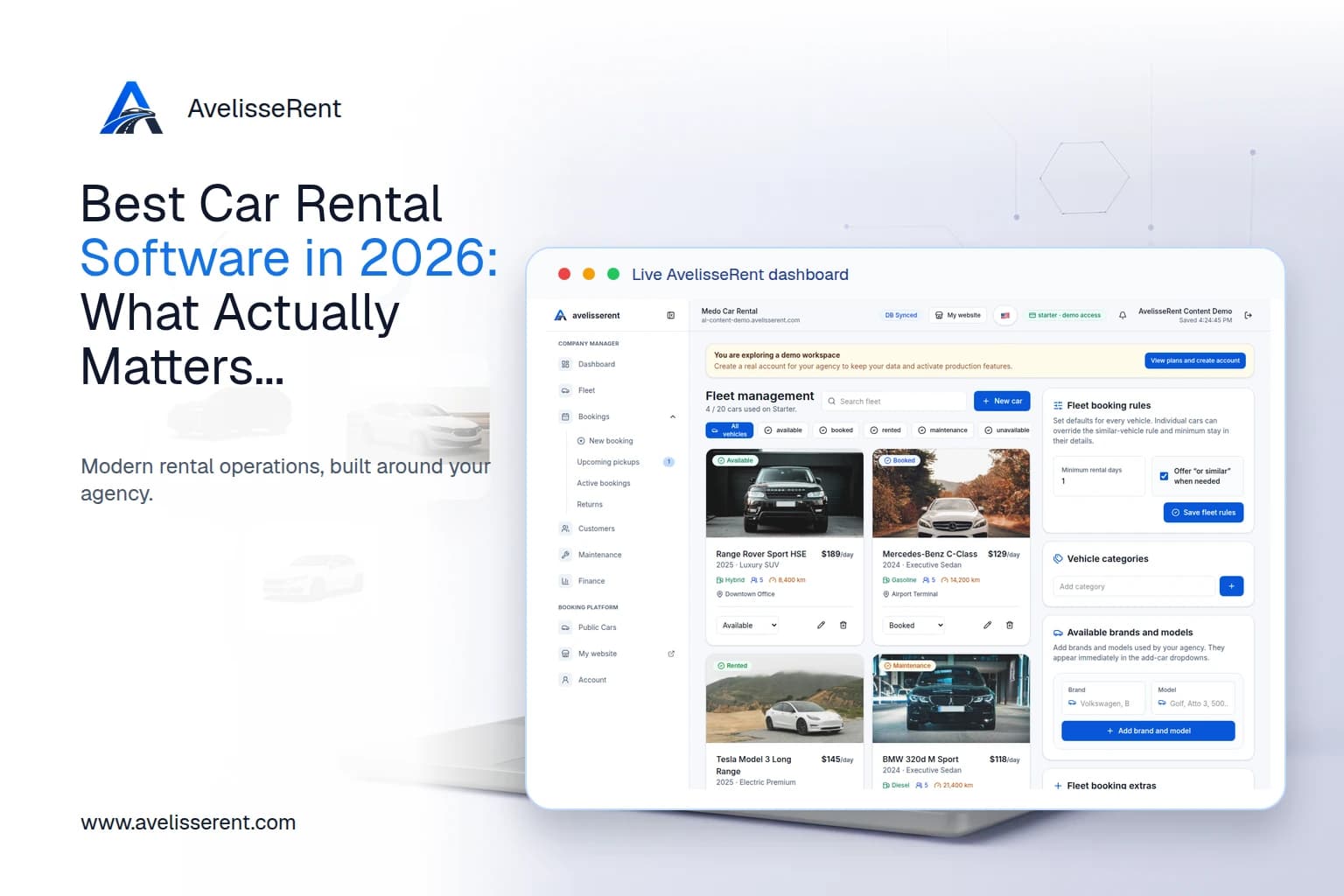
Keep every vehicle ready for the next booking
Organize vehicle details, pricing, availability, photos, and maintenance records from one rental dashboard.
Start your free trial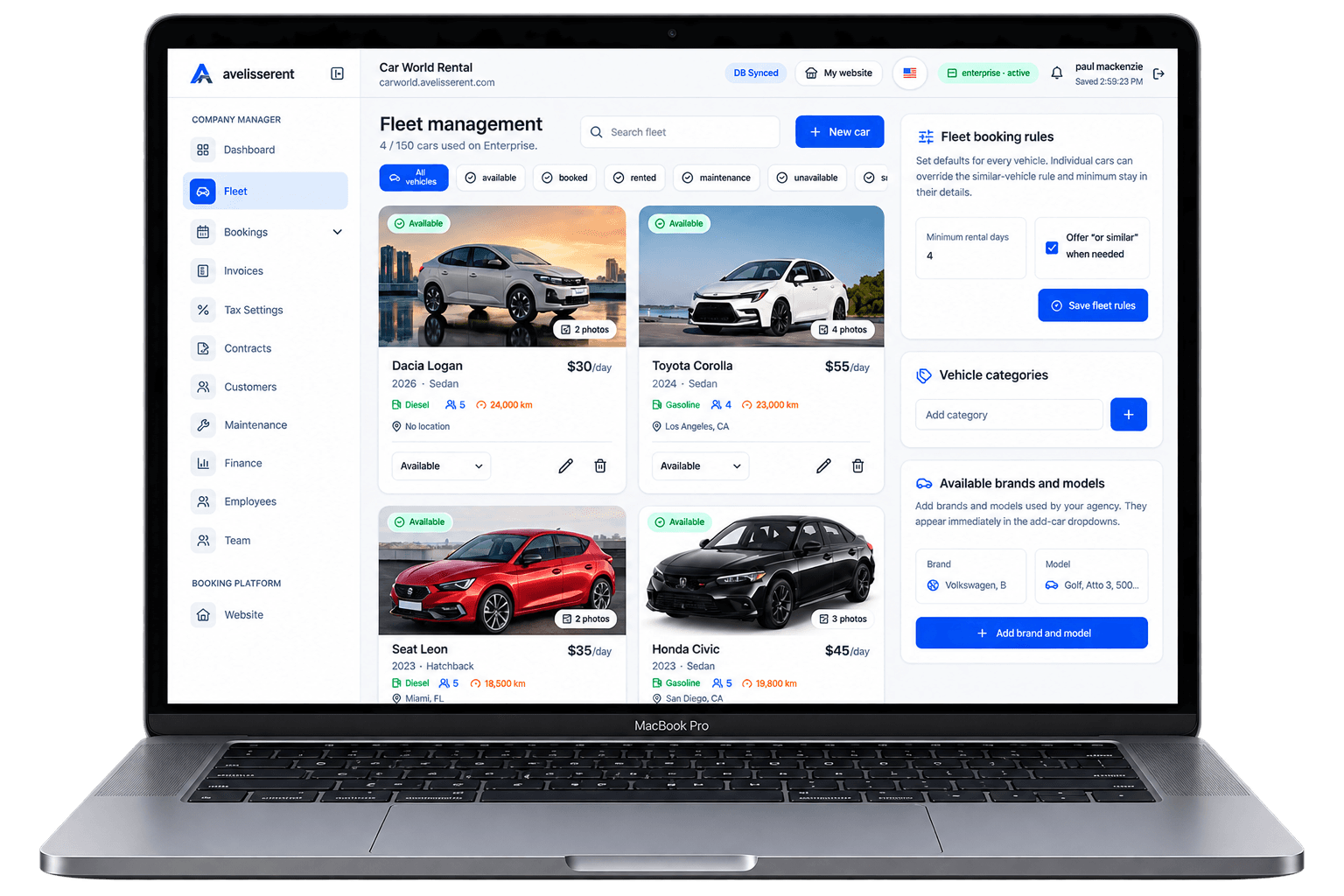
Running a car rental business involves much more than handing customers the keys to a vehicle.
Agency owners need to manage reservations, vehicle availability, customer information, rental agreements, payments, invoices, maintenance, employees, and their online presence.
When these operations are handled manually or across several disconnected tools, even a small rental agency can quickly become difficult to manage.
That's where car rental automation can make a major difference.
Modern car rental management software allows agencies to bring their daily operations together and automate many repetitive tasks.
What Is Car Rental Automation?
Car rental automation means using software to reduce the amount of manual work required to operate a rental agency.
Instead of maintaining separate spreadsheets, calendars, invoices, customer records, and booking requests, an agency can manage these activities through one centralized system.
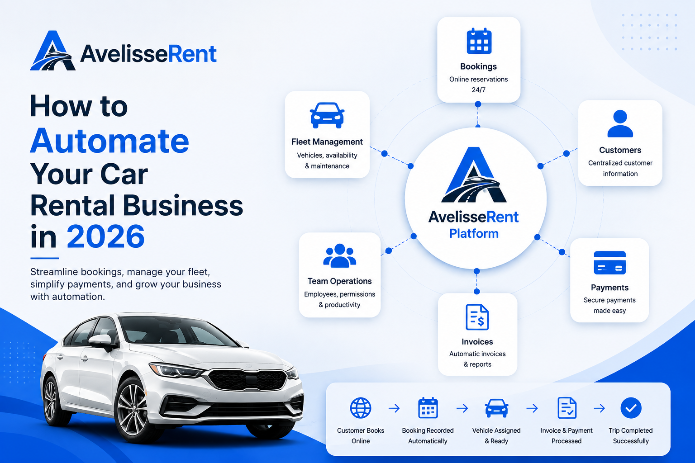
For example, a customer can submit a reservation through your rental website while your management system records the booking and updates the information available to your team.
The goal isn't to remove people from the business.
It's to let your team spend less time on repetitive administrative work and more time serving customers and growing the agency.
1. Move Away From Spreadsheets
Spreadsheets can work when an agency is just getting started.
But as the number of vehicles and bookings increases, spreadsheets become harder to maintain.
You may end up with separate files for:
- Vehicle information
- Customer records
- Reservations
- Payments
- Maintenance
- Expenses
- Invoices
This creates unnecessary duplication and increases the possibility of human error.
A centralized car rental management system gives your team one place to manage the agency.
With AvelisseRent, agencies can manage their fleet, bookings, customers, invoices, team and other daily operations from a centralized dashboard.
2. Automate Online Reservations
Customers increasingly expect to be able to discover vehicles and request or complete reservations online.
If every booking requires a customer to call, email, or send a message, your team has to manually process every request.
A car rental booking system can streamline this process.
Your website can present available vehicles, rental information and a booking flow directly to potential customers.
This means your business can receive booking requests even outside normal office hours.
Why does this matter?
Imagine a traveler searching for a rental vehicle late at night.
Agency A asks them to call tomorrow.
Agency B provides an online booking experience immediately.
Which agency is more likely to capture the customer?
Making your rental process easier can directly affect conversion.
AvelisseRent helps rental agencies combine their management dashboard with an online booking website, so customers and agency staff don't have to rely entirely on manual reservation processes.
Start your free AvelisseRent trial →
3. Centralize Fleet Management
Knowing the status of every vehicle is essential.
Your team should be able to quickly determine which cars are available, rented, reserved, unavailable or undergoing maintenance.
A proper car rental fleet management system can also keep important vehicle information organized, including details such as:
- Make and model
- Registration information
- Transmission
- Fuel type
- Mileage
- Rental pricing
- Vehicle status
- Maintenance information
- Vehicle photos and descriptions
Centralizing this information makes it easier for employees to understand the current state of the fleet without searching through multiple documents.
4. Automate Customer Management
Repeat customers are valuable to rental businesses.
However, customer information is often scattered across email inboxes, messaging applications, paper documents and spreadsheets.
A centralized customer database makes it easier to keep booking and customer information connected.
When a customer contacts your agency again, your team can work from organized records instead of starting from zero.
This becomes increasingly important as your agency grows.
5. Simplify Payments
Payment collection can become another source of administrative work.
A modern rental operation should have a structured process for recording and managing customer payments.
Depending on the agency's setup and payment provider, online payments can also be integrated into the booking experience.
This can reduce the need for staff to manually coordinate every transaction.
AvelisseRent is designed to help agencies manage their rental operations while allowing eligible businesses to configure supported payment functionality for their own rental websites.
6. Automate Invoices and Rental Records
Creating invoices manually for every reservation takes time.
It also makes maintaining consistent financial records more difficult.
A rental management platform can connect booking, customer and payment information so staff can manage invoices and rental records more efficiently.
This is especially useful for agencies processing dozens or hundreds of rentals each month.
7. Keep Your Team in One System
As an agency grows, multiple employees may need access to operational information.
One employee may handle reservations while another manages vehicles, customers or administration.
Without a centralized system, employees may communicate through messages, spreadsheets and handwritten notes.
That creates information gaps.
A centralized rental management platform gives the team a shared operational environment and helps management maintain better visibility over the business.
8. Build a Professional Online Presence
Automation isn't limited to internal operations.
Your website is also part of your rental system.
Instead of maintaining one system for your website and another for managing rentals, connecting the two can significantly simplify operations.
A professional car rental website should make it easy for visitors to:
- Explore your fleet
- View vehicle details
- Understand rental options
- Submit reservations
- Contact the agency
- Access important policies
Your website effectively becomes another sales channel for the agency.
What Should You Automate First?
You don't need to automate everything at once.
Start with the areas consuming the most time.
For many rental agencies, the best order is:
1. Fleet management
Organize all vehicles and their information.
2. Booking management
Move reservations into one system.
3. Online booking
Allow customers to start the rental process through your website.
4. Customer management
Centralize customer information.
5. Payments and invoices
Create a more structured financial workflow.
6. Team operations
Give employees the tools they need to work from the same information.
Once these core processes are connected, your agency becomes much easier to operate.
Benefits of Automating a Car Rental Business
The biggest advantage isn't simply using new technology.
It's reducing operational friction.
A well-designed car rental management system can help an agency:
- Reduce repetitive administrative work
- Keep vehicle information organized
- Manage reservations more efficiently
- Improve visibility across the fleet
- Provide customers with online booking options
- Centralize customer information
- Maintain more organized rental records
- Support a growing team
- Create a more professional customer experience
For a small agency, automation can save valuable administrative time.
For a growing agency, it can provide the operational structure needed to handle more vehicles and reservations without creating unnecessary complexity.
Manage Your Rental Agency With AvelisseRent
AvelisseRent is an all-in-one car rental management platform built for rental agencies.
Instead of combining spreadsheets, booking tools, customer records and separate operational systems, agencies can manage their business from one platform.
With AvelisseRent, you can manage:
- 🚗 Fleet and vehicles
- 📅 Reservations and bookings
- 👥 Customers
- 💳 Payments
- 🧾 Invoices
- 👨💼 Employees and team operations
- 🔧 Vehicle and operational information
- 🌐 Your agency's online booking website
- 📊 Your rental business from a centralized dashboard
Whether you're managing a small local fleet or building a growing rental company, AvelisseRent is designed to help you spend less time managing disconnected tools and more time growing your business.
Ready to Modernize Your Car Rental Business?
Stop managing your rental agency across spreadsheets, messages and disconnected tools.
Run your fleet, bookings, customers, payments, invoices, team and booking website from one place with AvelisseRent.
Start Your Free Trial
Explore AvelisseRent and see how a centralized rental management platform can simplify your agency's daily operations.
Frequently Asked Questions
What is car rental management software?
Car rental management software is a system designed to help rental agencies manage vehicles, reservations, customers, payments, invoices and other operational activities from a centralized platform.
Can a small car rental business use rental software?
Yes. Small agencies can benefit significantly because centralized software reduces the need to maintain multiple spreadsheets and manually track reservations and vehicle information.
Can customers book rental cars online?
With an online car rental booking system, agencies can provide customers with a website where they can explore vehicles and submit reservations online.
When should I switch from spreadsheets to car rental software?
If you're spending significant time updating spreadsheets, checking vehicle availability manually, coordinating reservations across different channels or correcting conflicting information, moving to dedicated rental management software may make operations easier.
What is AvelisseRent?
AvelisseRent is a car rental management SaaS platform designed to help rental agencies manage their fleet, bookings, customers, payments, invoices, team and online booking presence from one centralized system.

Mohamed Elazzabi
Founder & CEO of Avelisse Labs LLC | SaaS & App Developer | Content Creator
I'm Mohamed Elazzabi, Founder and CEO of Avelisse Labs LLC Launching AvelisseRent SaaS platform built to help car rental businesses simplify and automate their daily operations. I create content about car rental business growth, digital transformation, automation, SaaS, and technology, sharing practical ideas to help rental agencies work smarter, reduce manual tasks, improve customer experience, and grow their business. Building smarter tools for modern car rental businesses.